Shah Abbasi Medallion: Persian Rug Motif
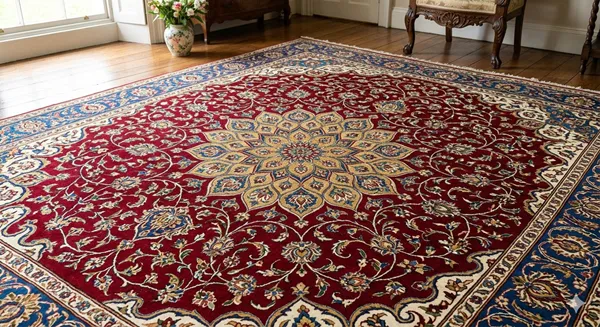
The Shah Abbasi Medallion is one of the most prestigious and recognizable motifs in Persian carpet weaving. Named after the Safavid ruler Shah Abbas I, who reigned during the “Golden Age” of Persian art in the 16th and 17th centuries, this design represents a pinnacle of floral symmetry and elegance.
Key Characteristics
The design is defined by several distinct elements:
- The Central Medallion: Typically large and ornate, often appearing as a blooming flower or a sunburst. It is designed to be the focal point of the rug, radiating outward toward the corners.
- Shah Abbasi Flowers: These are stylized palmettes and lotus blossoms that are more curvaceous and fluid than geometric motifs. They often feature intricate internal detailing.
- The “Eslimi” (Arabesque) Vines: The medallion is usually surrounded by a network of scrolling vines and creepers that connect the central piece to the rest of the field, creating a sense of continuous movement.
- Symmetry: The design almost always follows a strict four-fold symmetry, mirrored both vertically and horizontally.
Origin and Influence
While the motif originated in the royal workshops of the Safavid Empire, it has been adopted and refined by several famous weaving centers:
- Isfahan: Known for the highest level of detail and the use of fine wool or silk on a silk foundation.
- Kashan: Often utilizes the medallion with deep reds and blues, creating a very classic, formal aesthetic.
- Mashad: Frequently incorporates large, bold Shah Abbasi medallions with slightly more rounded, curvilinear patterns.
Symbolic Meaning
Historically, the central medallion is said to represent the “Eye of the Divine” or the sun, while the surrounding floral elements symbolize the Gardens of Paradise. It is a design intended to evoke a sense of spiritual harmony and earthly luxury.